Surface:
5050 km2 (of which 4340 km2 in Romania
and 710 km2 in Ukraine),
together with the flooded areas, sand banks and complex lagoon Razim - Sinoe.
The Delta area, formed in Quaternary period, in close connection
with the variation of the Black Sea and the
intake of rich alluvial Delta, has the appearance of a giant equilateral
triangle, with sides of c.80 km each.
At Ismail, the Danube
is divided in 2 arms: Chilia and Tulcea, and after about 17 km downstream the
Tulcea arm devides in two arms of Sulina and Sfantu Gheorghe. Between
these three arms of the large delta exists, mostly, the wonderful Danube
Delta teritorry which is made out of a lot of sand banks (river sand banks
Chilia Caraorman, Pardina, Stipoc, river-sea sand banks Letea, Sărăturile,
Crasnicol etc.), small lakes (Sontea, Papadia, Litcov, Lopatna ), lakes (
Merhei, Mataita, Fortuna, Gorgova, Trei Ozere, Rosu, Rosulet, Puiu ) and
swamps.
Danube Delta recorded in time, a slight entrance in the Black Sea, in the area around
the mouths of the Danube flow, phenomenon captured by the fact that the old
Sfantu Gheorghe light house is, currently, over 2 km from the shore of the
Black Sea
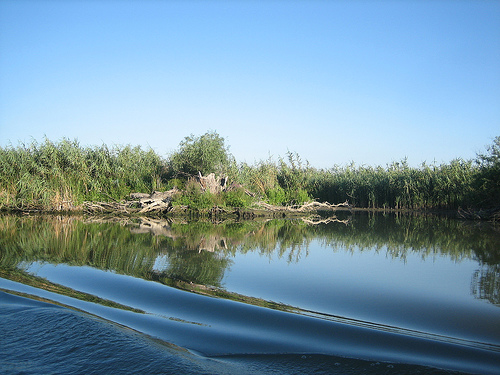
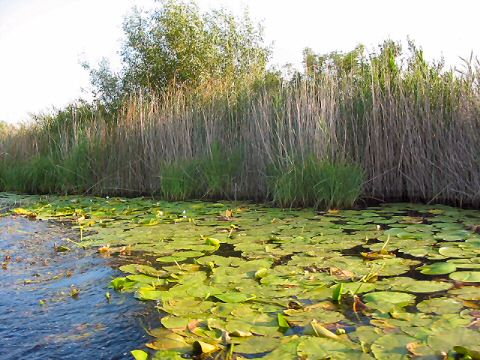
The vegetation is abundant, comprising of reed and sedge,
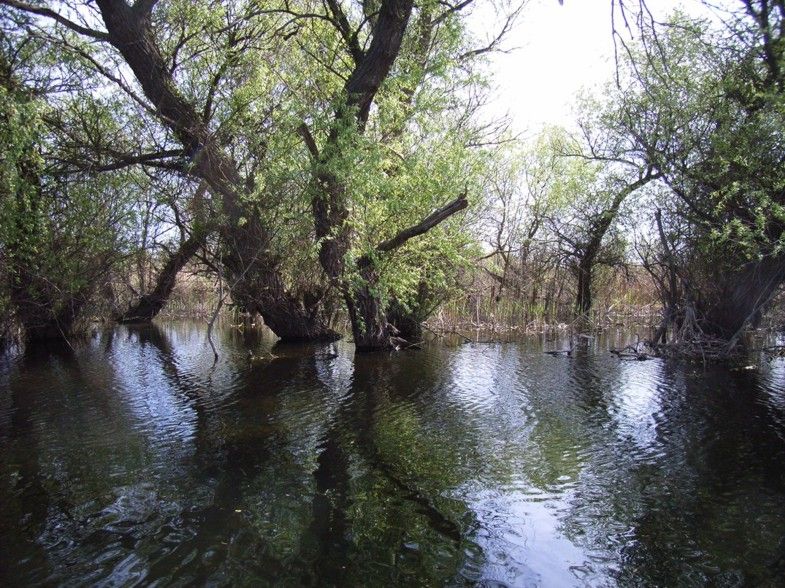
aquatic plants (especially water lilies). On the sand banks small forests of
soft woods (poplar and willow). On the larger sand banks (river-sea)
forests of oak, mixed with fluffy ash, elm, poplar grow. On them runner plants
are abundant, among which can be distinguished Periploca graeca and
wild vine (Vitis silvestris), which can reach very large sizes.
The Danube Delta represents a big turistical
attraction due to the fact that there is a wide variety of fish and
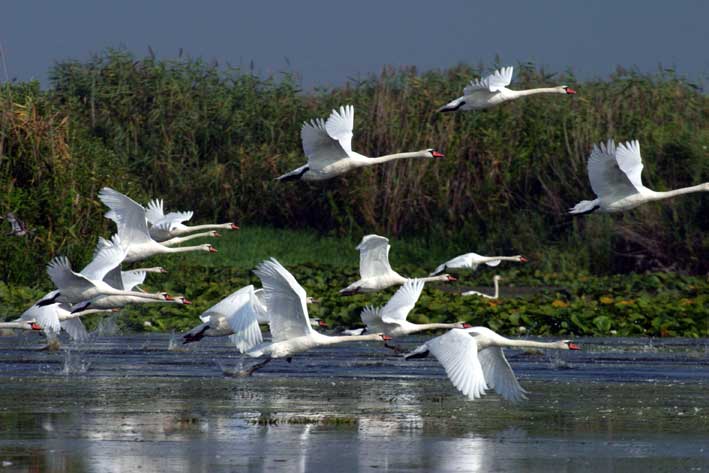
ornithological fauna (domestic and pass). Here you can meet more than 300
species of birds (storks, ducks and wild geese, woodcock, cormorants, egrets,
coot, heron, white and red califari, flamingo, swans, pelicans and white
pelican, hawls, white eagles, etc..) some of them declared natural monuments
and protected by law (pelican, red breasted goose / Branta ruficollis, which
winter in the Danube Delta).
The Danube Delta, as a unit apart of the relief,
can be noticed by a few characteristics
- the youngest relief unit in Romania
- the most compact area of reed (c.240.000 ha)
- the most extensive sand dunes on Romanian territory (about
20,000 ha)
- the largest beach on the Romanian coast of the Black
Sea (about 30 km long, 1-2 km wide)
- the largest lake in the country (Razim - 415 km 2)
- at highest hill river-sea (Letea - 17,000 ha)
- the lowest altitude in Romania
(Sulina - 3.5 m)
- the most easterly city of Romania
(Sulina )
- the richest and most varied fauna of Ornithology in Europe